The / Aura / Signal / AI / Solutions / Digital / Operations · 6 min read
The Aura Signal: AI gets more useful, and deployment gets more complicated
GPT-6’s interactive answers, Claude Haiku 5.5, open-model previews, and Windows hybrid AI lead our October 2–8 recap, plus six updates for builders and operators.
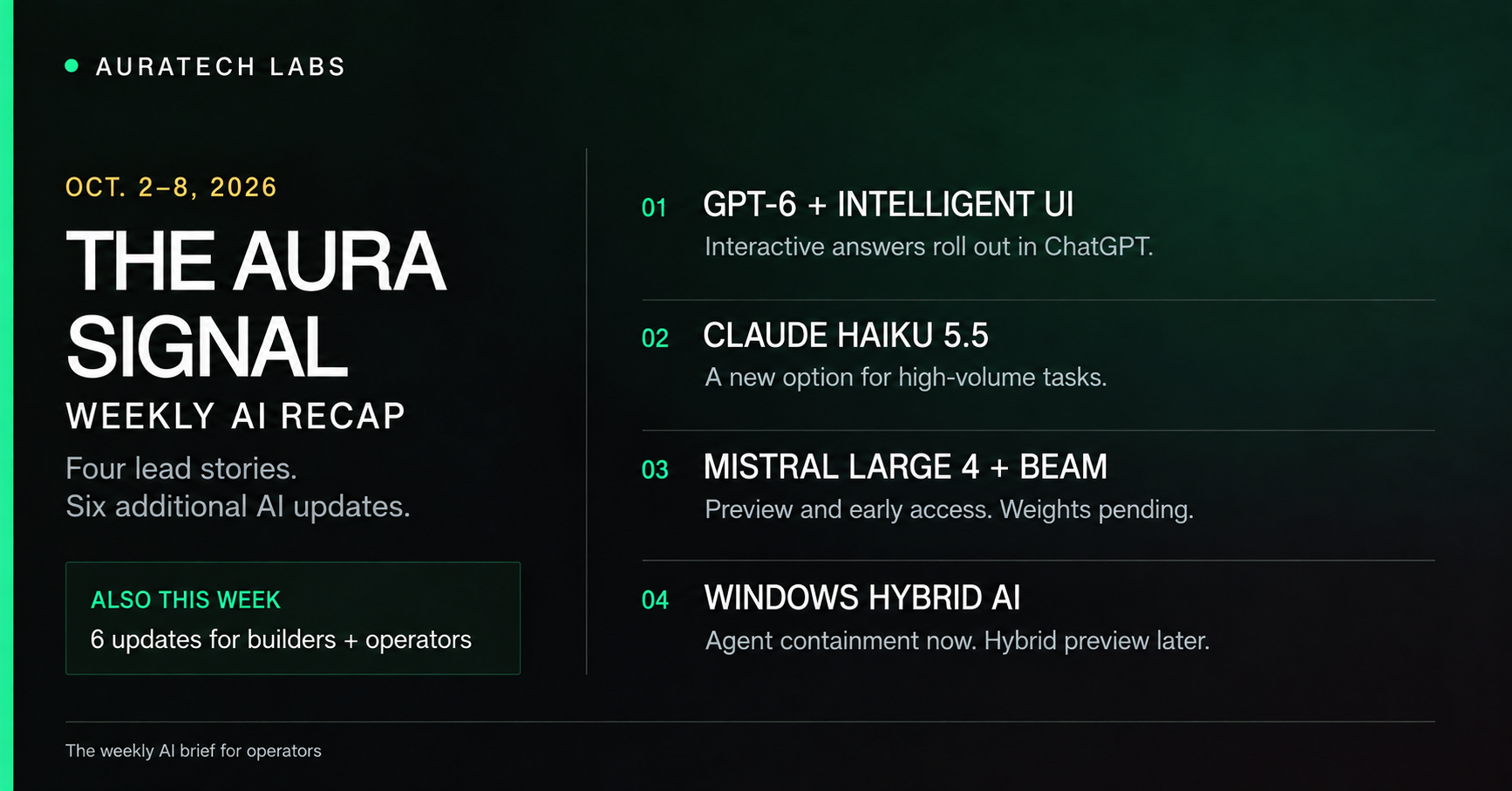
WEEKLY AI RECAP | OCTOBER 2–8, 2026
October 9 issue. Announcement and availability statements below refer to the reporting window, not a claim that every rollout is complete.
This week’s important AI news reached well beyond another model leaderboard. OpenAI expanded how people interact with ChatGPT. Anthropic introduced a smaller model aimed at repeated, narrowly scoped work. Mistral and Reflection offered fresh reasons to watch the open-model market. Microsoft put agent containment and local/cloud execution into the same Windows conversation.
The common thread is practical: more choices about how an AI system looks, what it costs, where it runs, and what it can touch. Those choices deserve separate decisions. A better interface does not validate its calculations. Lower token prices do not establish lower cost per successful task. An announced weight release does not put a deployable model in your environment.
Here are our four lead developments, followed by six additional updates worth tracking.
1. GPT-6 brings interactive answers to more ChatGPT users
On October 7, OpenAI announced a broader GPT-6 rollout with Intelligent UI: responses that can combine text with interactive components, rather than returning the same kind of chat answer for every question. The rollout began with paid tiers, with Free and Go expansion scheduled to start the following day. Enterprise access depends on administrator settings. OpenAI explicitly says this release changes ChatGPT’s Chat experience, not the models powering Work or Codex. OpenAI announcement
Our take: the useful shift is from reading an answer to working with it. A comparison, calculator, or explanation can become easier to interrogate when people can change inputs and see consequences.
That also raises the standard for review. A polished control can make an unsupported result feel authoritative. For business use, test the arithmetic, units, assumptions, and source dates behind an interactive response. Judge it by whether it helps someone reach a defensible decision, not by how convincingly it resembles finished software.
2. Claude Haiku 5.5 makes task routing worth revisiting
Anthropic introduced Claude Haiku 5.5 on October 7 for high-volume, cost-sensitive work, including summaries, classification, and bounded subagent tasks. It is available through the Claude Platform and major cloud platforms. Pricing varies with prompt length; a single headline discount is not an accurate description of every workload. Anthropic also distinguishes these smaller tasks from complex agentic coding, where its larger models remain the stronger recommendation. Anthropic announcement
Our take: test one repeatable job against the existing approach. Compare accepted outputs, retries, latency, and review effort. Escalate ambiguous cases instead of forcing an answer. Aim for lower cost per accepted result, with the acceptance standard unchanged.
3. Mistral and Reflection widen the open-model watchlist
Reflection announced Beam on October 5, opening early-access signups while final testing continued. Its weights, model card, and technical report were planned for later October. Mistral followed on October 6 with Mistral Large 4 in public API preview, with weights promised by the end of the month. These were meaningful announcements, but they were not two completed public weight releases during this reporting window. Reflection announcement, Mistral announcement
Both belong on the evaluation list for teams that care about deployment choice. Mistral emphasizes multimodal and professional workloads; Reflection emphasizes coding, reasoning, and agentic work. Their published results are reasons to test, not substitutes for a workload-specific comparison.
For private deployment, the next checkpoint is the actual release package: license, weights, serving requirements, model documentation, and reproducible behavior on your data. Until that package exists, plan an evaluation rather than a migration. Open weights can increase control, but they do not remove the work of operating, securing, and updating the system.
4. Windows puts agent boundaries beside hybrid AI
Microsoft’s October 7 Windows announcement combines several developments with different release states. Microsoft Execution Containers are generally available on Windows 11, providing policy-driven containment for agent activity. Local/cloud routing through GitHub HydraFusion is scheduled for an experimental preview later in October. Broader Copilot hybrid capabilities are expected over the coming months. Microsoft announcement
The immediate operating question is what an agent can access and execute. A local model is not automatically a private workflow if its tools can send information elsewhere. A sandbox is useful only when its permissions match the job.
Before expanding an agent’s reach, define the files it can read, destinations it can contact, changes it can make, and actions that require approval. Then test those boundaries. Evaluate local/cloud routing separately, including what leaves the device and what happens when the preferred model is unavailable. Treat containment, data handling, and model selection as related controls, not interchangeable promises.
ALSO THIS WEEK
Google’s Nano Banana 2.1, October 6. Google published the model card for its image-generation and editing model, including evaluations of design and editing quality. Its documented limitations still include small-text rendering, imperfect consistency, and factual errors. Better image generation still needs proofreading and provenance checks. Google DeepMind model card
Anthropic’s Cyber Mission, October 8. The initiative includes a Critical Infrastructure Defense Program and free, opt-in OSS Scanner service. Scanner reports are model-generated without human review, so maintainers need capacity to verify and prioritize findings. More discovered vulnerabilities are not the same as more safely deployed fixes. Anthropic Cyber Mission
Atlassian and OpenAI, October 6. Their expanded partnership connects frontier models with Atlassian’s enterprise context and Rovo. Deeper Jira integrations are described as exploratory, not universally available. For buyers, the useful question is whether an answer respects permissions and reflects current project decisions. Partnership announcement
Claude SDK computer and browser use, October 7. Anthropic announced beta support in its Python and TypeScript SDKs. Treat beta status as a reason for bounded testing, with explicit permissions and recovery paths. SDK announcement
Sonnet 5.5 cache pricing, October 7. Anthropic cut cache-read pricing. The effect on a particular application depends on its cache use and total workload; measure your own bill rather than applying a vendor headline percentage to the entire system. Pricing update
NVIDIA’s science commitment, October 8. NVIDIA announced commitments valued at $1 billion over five years for U.S. scientific computing and related research capacity. This is a multiyear commitment, not capacity delivered this week. Watch for concrete access programs and project milestones. NVIDIA announcement
What to do with this week’s news
Choose one decision to revisit, not six products to adopt. If repetitive tasks are expensive, compare routing options. If agents are gaining access to business systems, test their permissions and recovery behavior. If private deployment matters, prepare an evaluation set for the forthcoming weight releases.
Keep the baseline, record failures, and retain a rollback path. The strongest result from a busy news week is a better-informed operating decision, not a longer list of tools.
Editorial note: This recap prioritizes consequential builder and operator developments announced October 2–8. It is not an exhaustive news inventory. Product facts are linked to primary sources; operating recommendations are our analysis. We have not independently reproduced vendor benchmarks.