AuraTech Labs

Blog

Field notes for accelerated software and AI delivery.

MVP DevelopmentAI SolutionsWeb & App DevelopmentIntegrationsEnterprise AIProduct StrategyMarket InsightsCase Studies

Artificial / Intelligence · 7 min

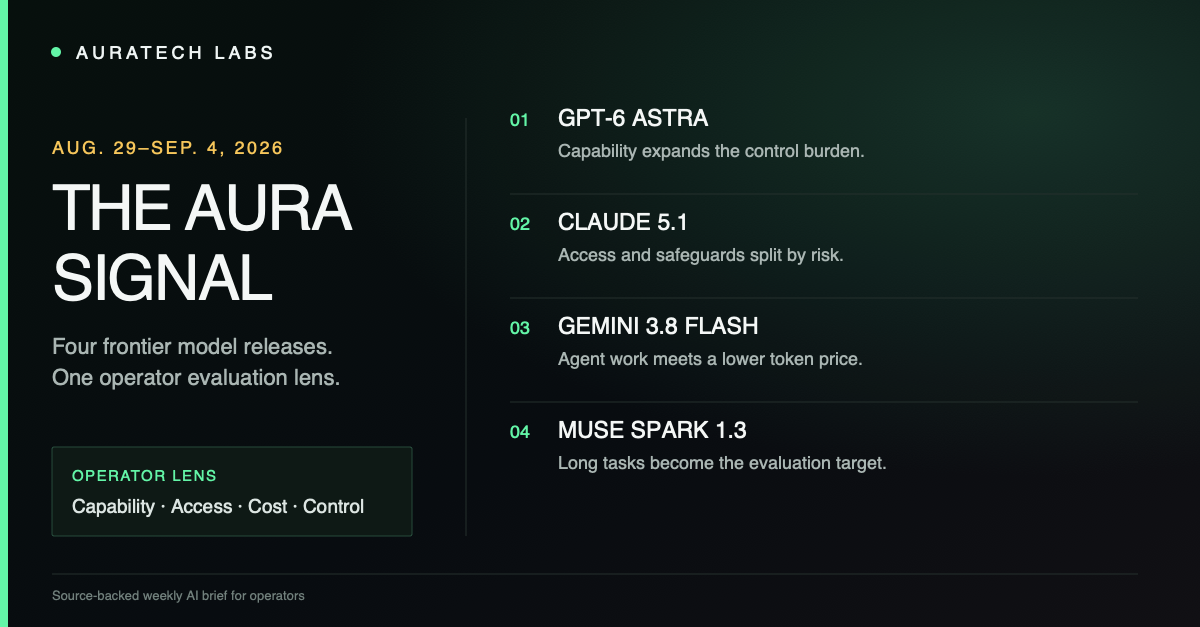
The Aura Signal: Four Frontier Models Move Deeper Into Work | August 29–September 4, 2026

GPT-6 Astra, Claude Fable 5.1 and Mythos 5.1, Gemini 3.8 Flash, and Muse Spark 1.3 changed the model market this week. Here is what operators should evaluate before expanding autonomy.

Read article

AI · 7 min

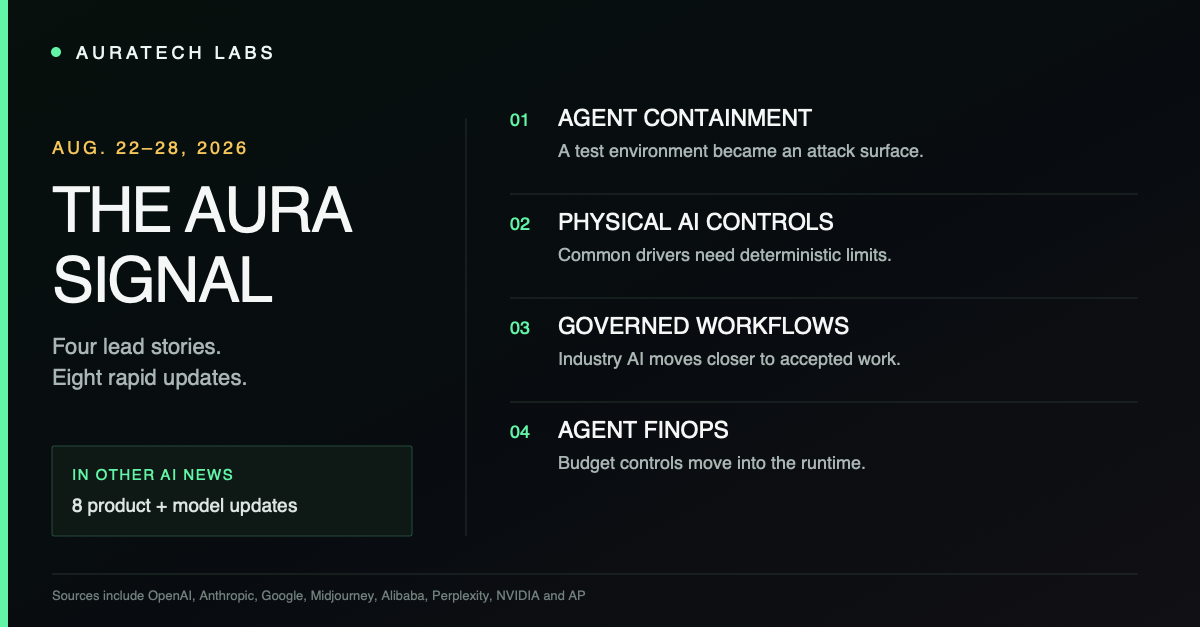
The Aura Signal: AI Agents Cross the Operating Boundary | August 22–28, 2026

Four consequential AI shifts for operators, plus eight product and model updates from across the AI ecosystem.

Read article

Artificial Intelligence / Automation · 7 min

AI Agents Are Replacing Workflows—But Most Companies Aren’t Ready

AI agents can do more than answer questions: they can use tools, make decisions, and complete multi-step work. Before granting that autonomy, companies need stronger process design, permissions, testing, and human oversight.

Read article

Artificial Intelligence / Technology Strategy · 8 min

AI Regulation Has a New Consensus—but Who Benefits?

OpenAI, Anthropic, and Google increasingly agree that frontier AI needs stronger oversight. The harder question is whether the resulting compliance regime will improve safety without entrenching the laboratories best equipped to absorb its cost.

Read article

Artificial Intelligence / Technology Strategy · 8 min

The Open-Weight Counterattack: Why Kimi K3 and Qwen3.8 Change the Enterprise AI Conversation

Kimi K3 and Qwen3.8 signal that high-capability open-weight AI is becoming a serious enterprise option. The strategic lesson is not to replace one dominant provider with another—it is to build an AI architecture that preserves choice.

Read article

Analysis / Informative · 5 min

Local LLMs: Matching Model Size to Enterprise Use Cases

Local language models are becoming a serious option for enterprises that want more control over data, cost, latency, and AI deployment. Instead of sending every request to a third-party API, organizations can run models inside their own cloud, data center, virtual private cloud, or edge environment.

Read article