The / Aura / Signal / Enterprise / AI · 6 min read
The Aura Signal: GPT-6 Sol, Luna, and Opus 5.5 change model economics
GPT-6 Sol and Luna, Claude Opus 5.5, robotics tooling, and security operations: what this week’s releases mean for model routing, token costs, and practical deployment.
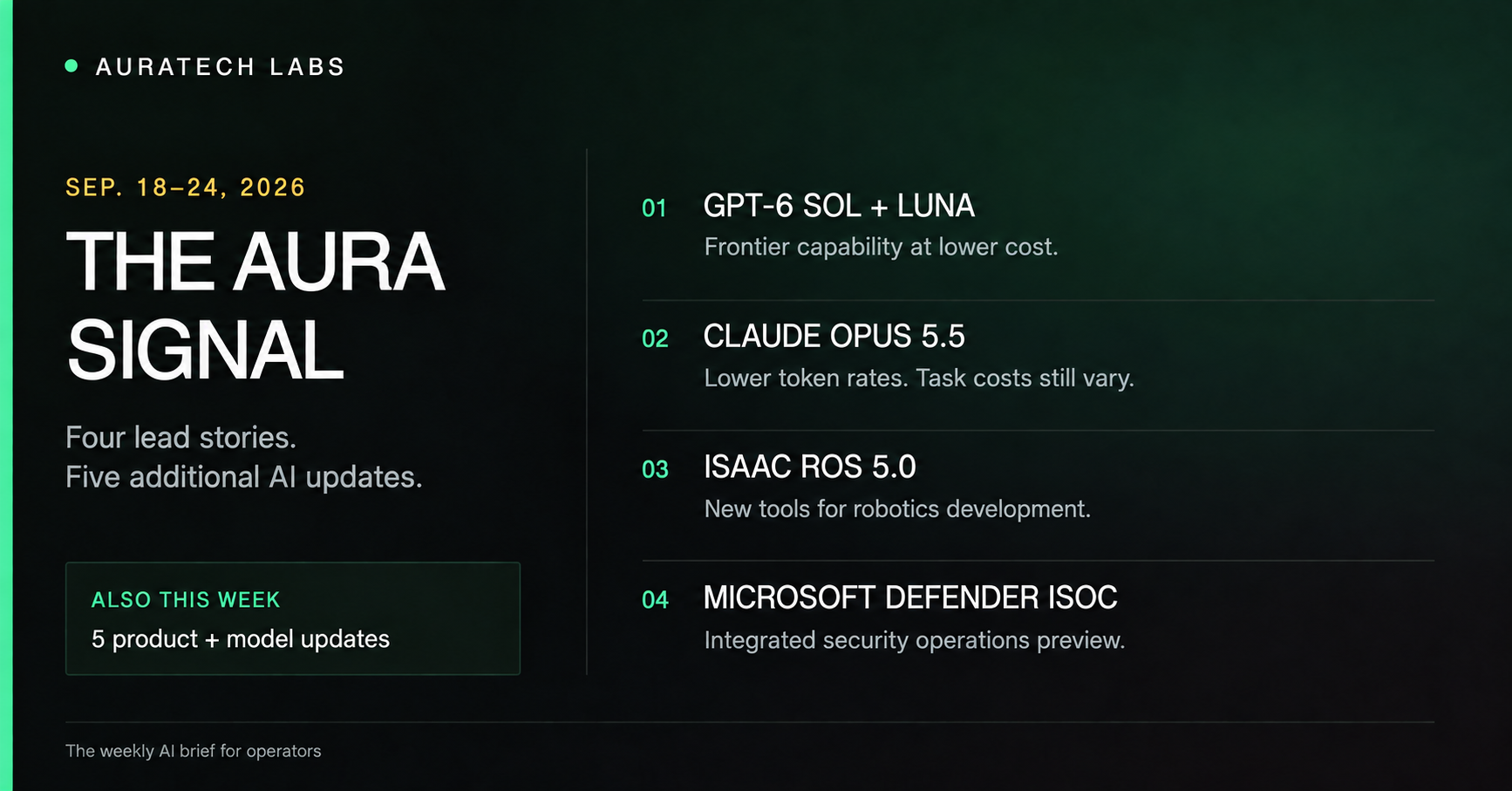
THE AURA SIGNAL | SEPTEMBER 18–24, 2026
WEEKLY AI RECAP
GPT-6 Sol and Luna, alongside Claude Opus 5.5, are this week’s lead story. Their September 22 releases make model selection more interesting than simply choosing the most capable model available. The practical opportunity is to match the model, reasoning effort, and review process to the work, while tracking what a finished result actually costs.
Our read: the opportunity is becoming more concrete, but so is the responsibility to define what a system is allowed to do. A cheaper answer is useful only if it helps finish the job correctly. A new connector matters only if its access is appropriate. And a robot that performs well in a demonstration still needs to handle the conditions of a real operating environment.
Here are four developments worth an operator’s attention, followed by five practical updates.
1. GPT-6 Sol and Luna change the model-selection conversation
OpenAI introduced GPT-6 Sol and Luna on September 22, with availability in its API, Codex, and ChatGPT Work. The announcement positions them as faster, more affordable alternatives within the GPT-6 family and reports improvements across coding and professional-work evaluations. At launch, the company explicitly distinguished ChatGPT Work availability from ordinary Chat. Launch announcement; dated announcement.
The operating implication is worth testing rather than accepting on a benchmark chart. Take a representative set of completed tasks, including awkward exceptions, and compare the total cost of obtaining an acceptable result. Count retries, tool calls, review time, and corrections alongside model usage.
Our view: Sol and Luna could fill an important gap in an Astra-led workflow. Keep the hardest planning and judgment with the strongest model, then evaluate the less expensive models for bounded implementation, extraction, and verification tasks. That is an architectural opportunity, not proof that Sol or Luna universally matches Astra. The useful routing rule is the one your own evaluation supports.
Before switching a production workflow, keep a baseline and a way to return to the previous configuration. Lower inference costs should create room for better validation, not an excuse to remove it.
2. Opus 5.5 raises the benchmark bar, with a cost caveat
Anthropic’s September 22 launch table places Opus 5.5 above Fable 5.1 on several evaluations, including Terminal-Bench 4.0 and GDPval-AA v2.1. These are reported benchmark results under specified settings, not a universal ranking. Anthropic itself cautions that real-world differences are narrower than the benchmark margins suggest. Opus 5.5 launch.
Standard API input and output rates are $4 and $20 per million tokens, respectively, versus Opus 5’s $5 and $25: a 20% reduction. The advertised estimate of 40% lower typical task cost is a different claim, incorporating workload and efficiency assumptions. It is not a 40% discount on every token.
The token question deserves equal prominence. Opus 5.5 uses always-on adaptive thinking, so visible answer length cannot tell you the full reasoning bill. But “it always requires far more tokens” is not established: the launch also reports fewer tokens on some completed tasks. API release and migration notes.
For an evaluation, record fresh input, cached input, reasoning/output, retries, and human correction. Compare the same accepted deliverable at explicit effort settings. A model can think more in a single turn yet finish in fewer turns; either effect can dominate the final bill.
3. Isaac ROS 5.0 brings AI assistance deeper into robotics development
NVIDIA released Isaac ROS 5.0 on September 22 at ROSCon in Toronto. The free, open source release adds support for ROS Lyrical and Ubuntu 24.04, reusable development skills, and documentation designed for AI-assisted workflows. Its supported Jetson range spans Orin Nano through Thor. NVIDIA announcement.
This matters to teams evaluating robotic inspection, handling, or manufacturing tasks because common development components can reduce the amount of software they must assemble themselves. It does not establish that a particular robot is ready for a particular site.
Our recommendation is to define the difficult operating cases before judging the demonstration: reflective parts, poor lighting, an obstructed camera, an unexpected object, or a failed grasp. Measure recovery as well as successful execution. Record when the system stops and how an operator resumes work.
For supply chain and manufacturing leaders, the first decision should remain specific: which bounded task is painful enough to justify a trial, and what evidence would make the trial successful? Better tooling can help answer that question. It cannot answer it on the operator’s behalf.
4. Microsoft previews a more integrated security operations center
On September 23, Microsoft announced its integrated security operations center, or ISOC, in Microsoft Defender. The preview brings security information and event management together with threat protection, aiming to give people and agents shared signals, context, and response controls. This is a preview announcement, not evidence that every customer can immediately replace an existing security architecture. Microsoft announcement.
Our takeaway is that the boundary between recommending a response and executing one deserves careful attention. Enriching an alert and disabling a production identity have very different consequences, even when both appear in the same workflow.
A sensible evaluation separates those actions. Start with historical incidents and supervised investigations. Check whether analysts can reconstruct the evidence behind a recommendation, identify the authority used for an action, and reverse a mistaken change where reversal is possible.
Speed matters, but a faster queue is not the same as better defense. Include missed detections, unnecessary disruption, and analyst correction effort in the assessment. Otherwise, an impressive automation rate can hide work that has merely moved elsewhere.
Also this week
Claude Marketplace expanded September 23 to combine connectors, products, and service partners. Claude Tag began rolling out personal connectors to Team-plan channels September 24, with Enterprise to follow; these do not run unattended routines. NVIDIA launched DSX Ready September 21 for power and cooling qualification, not site certification. Claude API cache diagnostics left beta September 23. Claude’s Microsoft 365 compliance-session endpoints left beta September 24. Marketplace; Claude release notes; Claude Tag; DSX Ready.
What to carry into next week
Choose one workflow that already has a clear owner and a measurable outcome. Preserve the current process as a baseline. Give the trial only the access it needs, and decide in advance what requires a person’s judgment.
Then review actual completed work. How often was it accepted without correction? Which exceptions required help? Did the total effort fall once review and recovery were included? Those answers are more useful than a broad claim that the organization has “adopted AI.”
The encouraging part of this week’s news is the range of practical places to begin. The discipline is choosing one, testing it honestly, and expanding only when the evidence supports it.