AI / Automation · 6 min read
The Aura Signal: Faster Models, Enforceable Boundaries | September 25–October 1, 2026
GPT-6.1 Sol, Sonnet 5.5, Copilot and NVIDIA lead a week of faster models and stronger runtime controls. What operators should test before expanding agent authority.
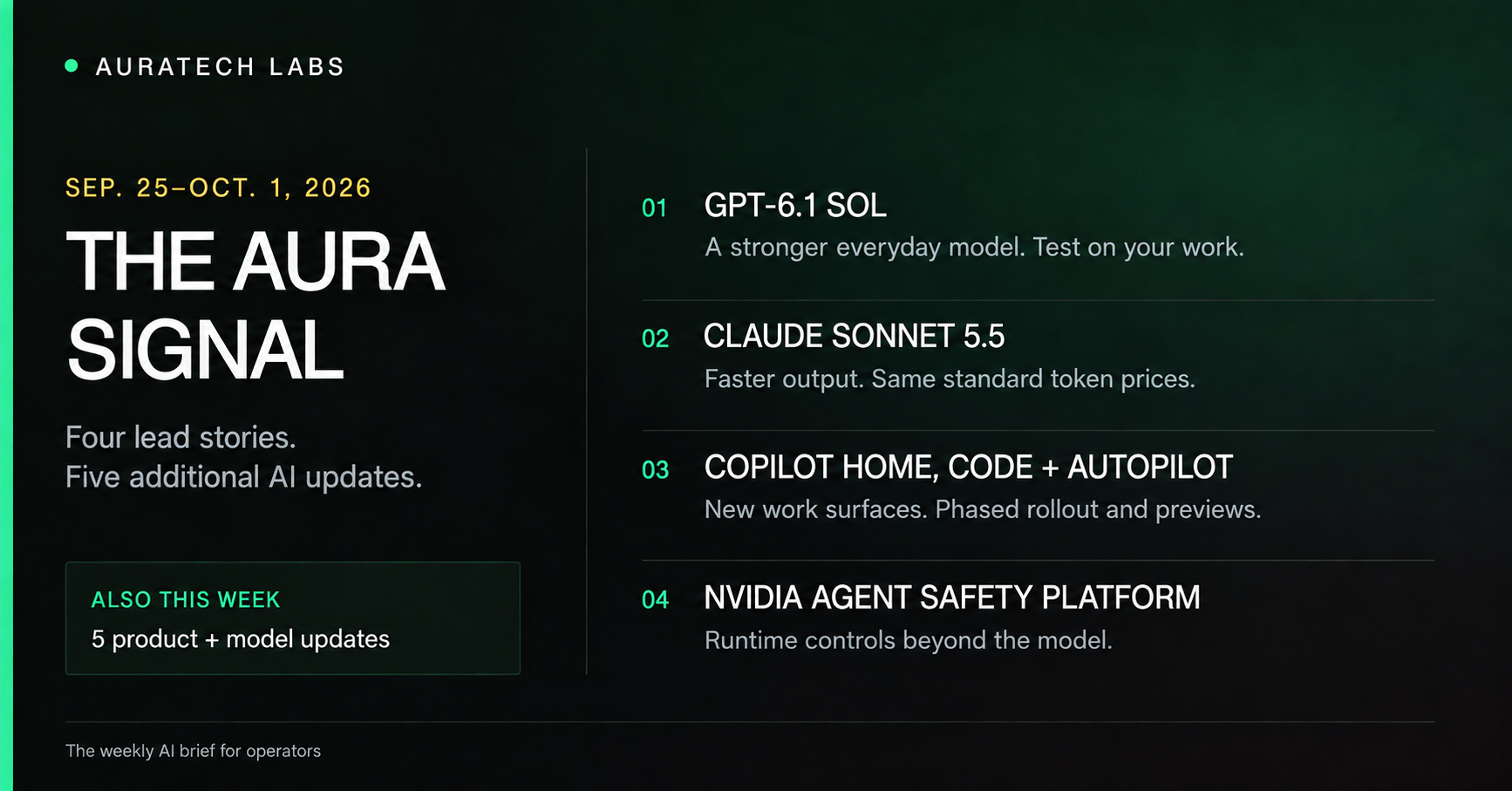
THE AURA SIGNAL | SEPTEMBER 25–OCTOBER 1, 2026
WEEKLY AI RECAP
This week brought stronger everyday models, new places to delegate work, and infrastructure designed to constrain what agents can do. GPT-6.1 Sol and Claude Sonnet 5.5 deserve evaluation. Microsoft’s Copilot announcements expand the work surface, while NVIDIA puts enforcement outside the model into focus.
Our view: the useful next step is a controlled comparison on a real workflow, not an automatic expansion of permissions. A faster assistant may clear its queue sooner. Whether the business benefits still depends on the quality of the result, the review it needs, and what happens when it goes wrong.
1. GPT-6.1 Sol expands the everyday model choice
On September 29, OpenAI introduced GPT-6.1 Sol for its API and ChatGPT Work and Codex. The launch announcement explicitly says it was not yet available in Chat. OpenAI reports improvements over GPT-6 Sol across coding, computer use and professional work, with several evaluations approaching GPT-6 Astra. Those are vendor evaluations, not a guarantee for a particular business process. OpenAI announcement
For an operator, a useful trial starts with work whose outcome can be checked. Examples include extracting fields from an approved document, preparing a reconciliation for review, or proposing a small code change with tests. Give the new model the same inputs, tools and acceptance criteria as the incumbent. Record incorrect outputs as well as completed ones.
We would also separate difficulty from consequence. A task may be easy to describe but expensive to get wrong. Updating a customer record does not become low risk because a model performs well on a coding benchmark. Keep the permission boundary fixed during the comparison so that increased access does not get mistaken for increased capability.
2. Sonnet 5.5 makes task efficiency worth measuring
Anthropic released Claude Sonnet 5.5 on September 28. It reports output generation more than 30% faster than Sonnet 5 and up to 30% lower cost per task in its testing. Standard input and output token prices did not fall: they remain $2 and $10 per million tokens, respectively. The claimed task savings come from using fewer tokens, not a universal discount. Anthropic announcement
Our takeaway is to measure the whole attempt. Include retries, tool calls, escalation to another model and human correction. A quick first draft that needs extensive repair can lose its advantage by the time someone accepts it. Conversely, a modest improvement on a frequent, well-bounded task can be useful without winning every benchmark.
Avoid changing the model, prompt, tool permissions and review rules at once. That makes a successful trial hard to explain and a failed one harder to diagnose. Start with a representative sample, keep the comparison conditions visible, and inspect the cases where the new model takes a different path.
3. Microsoft previews more ways to delegate work
Microsoft’s September 25 announcement introduced Copilot Home, Code and Autopilot. Home brings Chat and Cowork together; Code is intended for building solutions; Autopilot is a persistent agent experience. Availability is staggered: Home and Code were announced for phased Frontier rollout, while Autopilot was headed into private preview. Copilot Managed Runtime was also announced in preview. These should not be treated as a single generally available release. Microsoft announcement
For teams evaluating generated internal apps, the important handoff is from a useful experiment to something coworkers depend on. Who owns the app after its creator changes roles? Which data can it read? Who approves changes, and how is support handled? A tenant-hosted runtime can help with deployment, but it does not supply the business owner or acceptance decision.
Our recommendation is to pilot one small shared solution with an explicit retirement or support plan. Demonstrate how access is removed and how a bad change is reversed before making it part of a recurring operational process.
4. NVIDIA puts agent controls outside the model
NVIDIA announced its Open Agent Safety Platform on September 28. It combines OpenShell runtime software with a Sentry reference system design. OpenShell is broadly available; Sentry describes an out-of-band hardware watchdog using BlueField-4 DPUs. The announcement is evidence of a product and architecture direction, not proof that every participating organization has deployed the complete design. NVIDIA announcement
The operating distinction matters: asking an agent to obey a rule and enforcing that rule through its environment are different controls. Teams should be able to identify which layer prevents an unauthorized tool call, where denied actions are recorded, and who can grant an exception. The answer should remain clear even when the model misinterprets its instructions.
For a practical evaluation, test both an allowed action and a deliberately disallowed one in an isolated environment. Confirm that the latter is blocked, that the evidence reaches the responsible operator, and that legitimate work can resume. Do not infer application correctness or physical-system safety from a runtime boundary alone.
ALSO THIS WEEK
OpenAI began rolling out Dots on September 29 for eligible users, with enterprise access subject to administrator enablement; its Agents API added computer use alongside other developer announcements that day; Microsoft detailed Fabric IQ in Copilot Chat and Cowork on September 28, extending governed Power BI context, with availability already announced September 25; CoreWeave announced Vera Rubin NVL72 availability on September 30, with early-access deployment and customer-test qualifications; Vercel added Microsoft AI audio models to AI Gateway on October 1, including speech generation and streaming transcription.
What to test next
Choose one workflow where an accepted result is easy to define. Compare the new model against the current approach without broadening its authority. Then test the surrounding system: unavailable data, a denied action, an interrupted run and the operator’s recovery path.
The release notes tell us what is newly possible. A bounded trial tells us what is useful here. Keep those two kinds of evidence separate, and the pace of announcements becomes easier to manage.
Coverage is September 25–October 1, 2026. Product status reflects the cited announcements. Performance claims are attributed to their publishers; this brief does not report independent AuraTech benchmarks.