Artificial / Intelligence · 7 min read
The Aura Signal: Four Frontier Models Move Deeper Into Work | August 29–September 4, 2026
GPT-6 Astra, Claude Fable 5.1 and Mythos 5.1, Gemini 3.8 Flash, and Muse Spark 1.3 changed the model market this week. Here is what operators should evaluate before expanding autonomy.
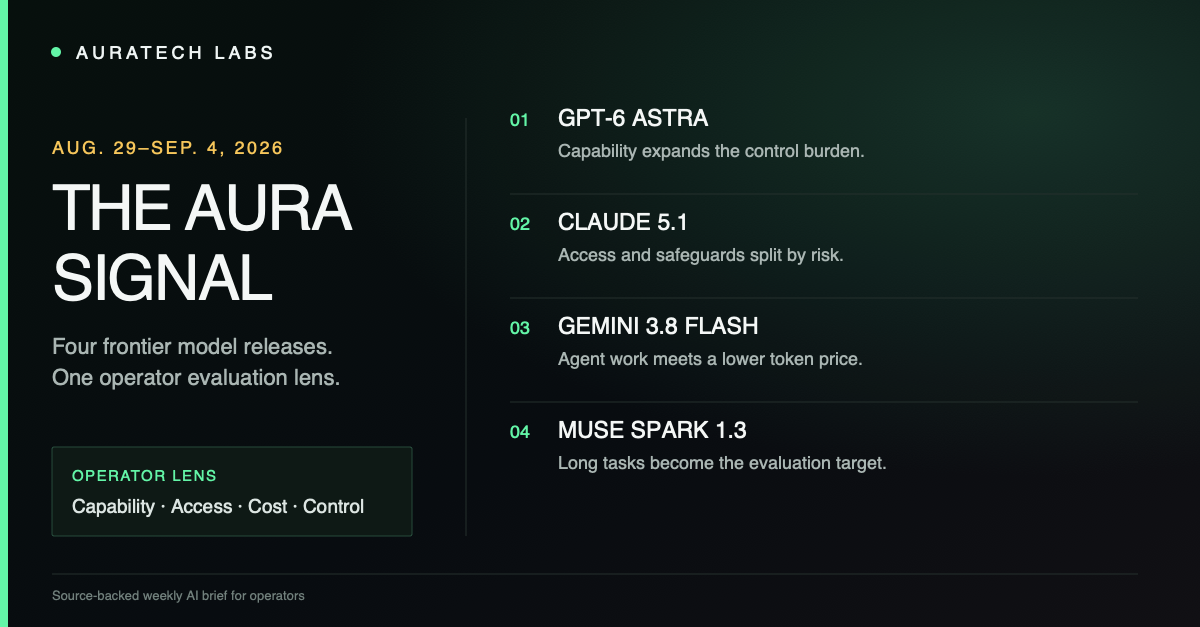
This week, four major model releases made the direction of the AI market unusually clear. OpenAI, Anthropic, Google, and Meta all moved their systems toward longer tasks, broader tool use, and more complete professional work.
The important distinction is not which launch won the week. It is how each provider packages capability, access, cost, and control. Those choices now shape what an organization can safely put into production as much as benchmark scores do.
Here are the four developments operators should carry into model evaluation and architecture decisions.
1. GPT-6 Astra expands the capability envelope and the security burden
OpenAI released GPT-6 Astra on September 3 with a phased rollout to selected organizations, paid ChatGPT plans, the OpenAI API, Azure, and AWS Bedrock. The company positions Astra for computer use, coding, research, scientific work, and polished business artifacts.
The most important release detail is not a benchmark. OpenAI says Astra meets its Critical threshold for cybersecurity capability under the Preparedness Framework. The launch describes stronger vulnerability discovery and exploit development, alongside additional safeguards and limited early access.
Independent reporting from Reuters and Axios placed the release in the context of growing scrutiny over agent safety and model monitoring. That context matters. Better computer use means more productive automation, but it also gives the model more opportunities to act through browsers, terminals, business systems, and credentials.
For an operator, Astra should trigger a new control review before it triggers a broad model swap. Test it with the same tool permissions, data boundaries, and failure conditions it would face in production. Record when it asks for clarification, when it exceeds intended scope, how it handles an unavailable tool, and whether a human can stop and reconstruct the run.
The practical question is not whether Astra can complete a difficult task. It is whether the surrounding system can safely govern the new tasks it makes possible.
2. Anthropic split frontier capability across access and safeguard tiers
Anthropic introduced Claude Fable 5.1 and Claude Mythos 5.1 on September 1. They are the same underlying model with different safeguard and access policies.
Fable 5.1 is generally available for coding and knowledge work. Mythos 5.1 is limited to vetted cybersecurity and life sciences organizations. Anthropic says Fable 5.1 improves long running problem solving and reduces the estimated cost of typical token billed workloads through lower cache read pricing. The company also reports fewer false positive interventions in its cyber safeguards.
The release makes an architectural point that procurement teams should not miss: model identity no longer tells you the full product behavior. The effective system includes the safeguard tier, fallback routing, retention policy, access program, and cloud path.
Anthropic also announced Enterprise Frontier Safeguards, scheduled to roll out in phases beginning later this fall. EFS is designed to store monitoring data in customer controlled cloud infrastructure while supporting automated misuse detection. Eligible customers receive zero data retention access to Fable 5.1 during the transition.
Before adoption, document which model actually handles each request, what data is retained, where logs live, who can review them, and which tasks are redirected or blocked. Those are operating requirements, not footnotes.
3. Google made the workhorse model more capable and introduced a trusted cyber tier
Google released Gemini 3.8 Flash and Gemini 3.8 Flash Cyber on September 2. The standard model is available through Google AI Studio, Gemini Enterprise, the Gemini app, AI Mode in Search, and Google Sheets. Google lists an introductory API price of $0.75 per million input tokens and $3.75 per million output tokens through December 31, 2026.
Gemini 3.8 Flash targets software engineering, agent tasks, and complex reasoning while preserving the speed and cost profile associated with the Flash line. Google also notes that higher effort settings may use more reasoning steps and tool calls, so the price per token is only one part of the cost model.
Gemini 3.8 Flash Cyber uses the same core intelligence with more permissive cybersecurity controls. Access is limited to trusted defenders through Google's new Fairwind Program. Google pairs the model with its CodeMender harness for vulnerability discovery, verification, and patch preparation.
The operator lesson is to evaluate the complete run, not the model rate card. Measure accepted completions, total tokens, tool calls, latency, review time, and recovery work at each effort setting. A lower token price does not guarantee a lower cost per accepted result.
4. Meta tuned Muse Spark 1.3 for longer, messier work
Meta released Muse Spark 1.3 on September 2 in Muse Code and the Meta Model API. The company says the update is better at preserving instructions, handling multiple workflows in one thread, asking for help when blocked, and confirming before consequential actions.
Meta also reports that, compared with Muse Spark 1.2 in its internal engineering comparisons, version 1.3 used about 20 percent fewer tool calls and 25 percent fewer tokens. Max reasoning is planned after additional safety testing; other reasoning modes are available now.
This is a useful shift in evaluation language. Long tasks fail in ways that a single answer benchmark does not capture. A model can produce strong isolated outputs while still losing requirements, confusing parallel work, or continuing after a decision should return to a person.
Teams testing Muse Spark 1.3 should use interruption and steering scenarios, not just clean prompts. Change a requirement halfway through, introduce conflicting evidence, make one tool unavailable, and insert a decision that requires approval. Score whether the system preserves the original goal, keeps workstreams separate, exposes uncertainty, and pauses at the right boundary.
Also this week
Flower Labs launched Endeavor 1.0 in a limited preview with managed and private deployment options. Flower's performance figures are company reported and still need independent reproduction.
Google launched WeatherNext 3 with hourly forecasts based on current satellite observations, higher resolution, and access through several Google products and Cloud services.
Google added agentic video understanding to several Gemini Flash models. Google reports lower token use and cost on its tests because the model can inspect selected moments instead of sampling an entire video at a fixed rate.
OpenAI added an Epic integration and a Healthcare Public Data plugin to ChatGPT for Healthcare, bringing authorized record context and nine official public data sources into governed workspaces.
AWS made Agent Registry generally available as a private catalog for agents, tools, skills, MCP servers, and related resources, with approval and discovery controls.
Anthropic published a commerce agent blueprint with reference shopping and merchant agents, tools, skills, guardrails, and evaluation guidance.
What operators should do next
This was a model release week, but the durable signal is about system design. The leading providers are all selling more than intelligence. They are packaging reasoning effort, tool loops, safeguards, access programs, retention choices, and deployment paths.
Use a shared evaluation contract before changing providers or expanding autonomy:
Define the task, accepted outcome, and evidence required for approval.
Run the same representative cases across candidate models and effort levels.
Measure total task cost, latency, tool failures, human review, and recovery work.
Test prompt injection, unavailable tools, conflicting instructions, and interrupted runs.
Verify exactly where data, logs, credentials, and approvals live.
Expand permissions only after repeated, reconstructable success.
The release cadence will keep accelerating. A stable evaluation and control layer is how an organization can benefit from that pace without rebuilding its operating policy every week.
Sources
OpenAI, GPT-6 Astra: A new generation of intelligence, September 3, 2026
Axios, Welcome to the AGI era, OpenAI says as GPT-6 Astra debuts, September 3, 2026
Anthropic, Introducing Claude Fable 5.1 and Claude Mythos 5.1, September 1, 2026
Anthropic, Developing Enterprise Frontier Safeguards with our customers, September 1, 2026
Axios, Anthropic releases new models, cost structures and safeguards, September 1, 2026
Google, Introducing Gemini 3.8 Flash and 3.8 Flash Cyber, September 2, 2026
Ars Technica, Google releases Gemini 3.8 Flash, September 2, 2026
Meta AI Research, Introducing Muse Spark 1.3, September 2, 2026
Google, Introducing agentic video understanding with Gemini, September 1, 2026
OpenAI, Healthcare organizations can now connect EHR and industry data to ChatGPT, September 1, 2026
Anthropic, Building commerce agents with Claude, September 2, 2026