The / Aura / Signal / AI / Insights · 4 min read
The Aura Signal: AI Gets Specific About Work | September 11–17, 2026
Four developments in legal research, CRM actions, scientific computing, and business analytics, plus five product updates and what to evaluate next.
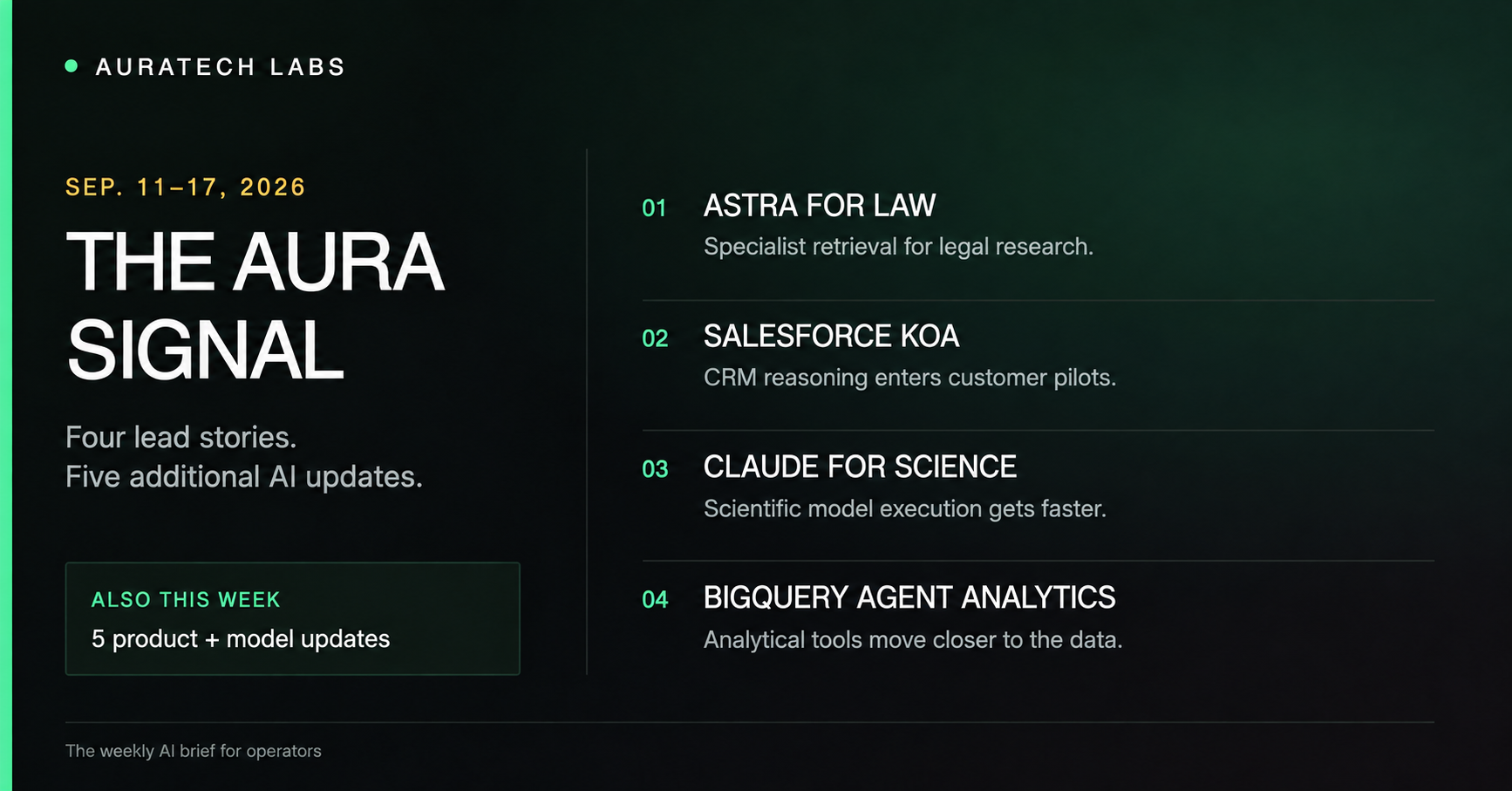
The Aura Signal | September 11–17, 2026
This week's useful AI news is becoming more specific to the work. Legal research, CRM actions, scientific computing, and business analytics each received a different kind of improvement. That makes comparisons more interesting, and buying decisions less suited to a single model leaderboard.
The question for an operating team is where the improvement comes from. Is it better retrieval, training around a particular workflow, faster execution of an existing model, or a more useful tool connected to the data? Those are different investments. They need different tests before a team can decide whether the result is worth adopting.
1. Astra for Law puts legal sources beside the model
OpenAI announced Astra for Law on September 17. It combines GPT-6 Astra with legal instructions and a search index spanning more than 230 million URLs. Initial access is limited to selected firms through Trusted Access; API availability is forthcoming.
OpenAI reports 54.0% overall correctness on a 200-question legal research evaluation at its highest reasoning setting, versus 38.7% for Astra using ordinary web search. This is a vendor evaluation of a particular setup, not a promise of accuracy on a firm's matters.
Our reading: the retrieval layer deserves its own evaluation. Test whether an answer finds the relevant authority, represents it correctly, and makes missing evidence visible. A more capable model does not remove the need for professional review.
2. Salesforce's Koa specializes in CRM actions
Salesforce and NVIDIA announced Koa on September 15. Built from Nemotron 3 Super, it was trained further using synthetic scenarios reflecting CRM workflows. Salesforce says no customer data was used in that training. Koa is in selected customer pilots, with U.S. general availability expected in winter 2026.
The design targets sequences of business actions rather than only good answers. Salesforce also controls the model weights and runs inference inside its infrastructure. Its performance claims come from its own CRM benchmark.
The evaluation question is practical: can the system complete your actual process, including exceptions? A correct next step in an isolated test may still fail when a customer record is incomplete, a policy changes, or a tool returns an unexpected result. Pilot access is an opportunity to test those cases, not evidence that they are already solved.
Source: Salesforce, September 15
3. Anthropic improves the tools scientists already use
Anthropic reported on September 17 that an internal research model, supervised by two technical staff members, optimized more than 30 biological models in under four weeks. The company reports roughly fourfold average acceleration with small numerical differences, and nearly twofold acceleration with identical outputs. It released the optimization code publicly.
The distinction between those modes matters. A speed comparison should state whether outputs remain identical, whether downstream quality was checked, and which hardware was used. The report also separates successful computation on very large systems from accurate predictions: running a larger problem does not by itself establish that the result is correct.
This is a useful direction for AI adoption beyond chat. Improving existing computational tools can make established work more accessible. Teams should still validate the exact configuration they plan to use.
Source: Anthropic, September 17
4. BigQuery brings analytical building blocks to agents
Google introduced six BigQuery analysis functions on September 14 covering metric drivers, causal effect estimates, correlation, change points, trends, and seasonality. They produce structured SQL results and can be used through Conversational Analytics, allowing an investigation to connect several analytical steps without moving the underlying data into a separate tool.
For operators, the opportunity is a more repeatable investigation. Detect a change, inspect the affected segments, and examine an explanation using explicit inputs. Keep the query, time window, comparison group, and assumptions alongside the narrative.
A function name is not sufficient evidence for a business conclusion. In particular, an estimated effect still depends on the comparison and its assumptions. Ask an analyst to review the method before turning a generated explanation into a management decision.
Source: Google Cloud, September 14
Also this week
ChatGPT for Word becomes generally available. OpenAI announced broader access alongside Astra for Law, bringing proofreading, suggested edits, and formatting checks into Word. September 17 announcement.
Copilot adds model selection preferences. Efficiency, balance, and intelligence tiers let users influence the cost, quality, and latency tradeoff; billing follows the selected model. GitHub, September 14.
AI Scan expands eligible repository coverage. GitHub's public preview no longer requires CodeQL default setup, although code scanning and AI Scan must still be enabled. GitHub, September 16.
Copilot reports engagement by feature. New aggregate reporting distinguishes use across experiences such as CLI, code review, and the app. Adoption counts should not be confused with productivity gains. GitHub, September 17.
Gmail expands AI search summaries internationally. Google's September 15 update describes wider English-language access on eligible paid plans, with regional exclusions for some consumer accounts and rollout timing that varies by release track. Google Workspace, September 15.
What to put on next week's test plan
Choose one recurring task with a result that someone can judge. Write down the current inputs, the accepted output, and the person responsible for that judgment. Then change one part of the system at a time. Otherwise, a better result may be real but difficult to explain or reproduce.
Keep three records: what was available to the system, what it produced, and what the reviewer had to change. Include unsuccessful cases. The failures are often more useful than the demonstration because they reveal whether the missing piece is information, a tool, a business rule, or human judgment.
Finally, separate product status from test results. An announcement, a limited pilot, and general availability are not interchangeable. Nor does availability establish suitability for your organization. This week's releases offer several concrete things to evaluate; none removes the need to define what a successful result means for the people doing the work.
Coverage window: September 11–17, 2026. Product status reflects the linked announcements. Vendor results are attributed, not independently reproduced. Analysis and suggested evaluation steps are AuraTech Labs' interpretation.